|
MYTH MAN'S
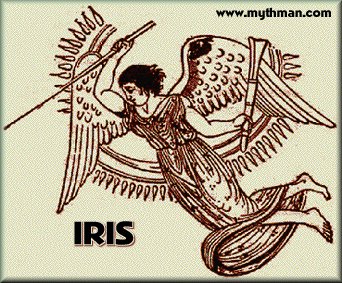
HOMEWORK HELP CENTER In Greek mythology, Iris is the personified goddess of the rainbow. She is regarded as the messenger of the gods to humankind, and particularly of the goddess Hera whose orders she brought to humans. She is able to change shapes and when delivering messages to mortals Iris assumes the appearance of a mortal known to those who receive the message. Iris is the daughter of the Titan Thaumas and the nymph Electra. Thaumas (his name means "wonder") is a Greek sea god and the son of Pontus and Gaia (Mother Earth). By the Oceanid Electra he fathered the Harpies and Iris. Iris once saved her siblings from death. The Harpies were loathsome winged female creatures who daily would swoop down and eat and befoul the food of the blind seer Phineus. When the Argonauts Calais and Zetes, winged sons of the North Wind, Boreas, caught up with the Harpies and were about to kill them, Iris appeared and beseeched the sons of Boreas to spare the lives of the Harpies. She promised that if they let them live, the Harpies would never again bother Phineus. One of her tasks is to deliver the sacred water of Styx. When quarrel arises among the gods, and when anyone among the Olympians lies, then Zeus sends Iris to the river Styx in the Underworld to bring in a golden jug the oath of the gods. Zeus caused oaths to be sworn by the water of Styx. If any of the gods drinks of her water and is untrue, he/she lies breathless for a year, never tastes Ambrosia and Nectar and lies down spiritless and voiceless. After spending thus one year in sickness he/she is cut off for nine years from the gods' councils and feasts and cannot return until the tenth year. In Homer's Iliad, Zeus sent Iris with a message for King Priam of Troy, instructing him to secretly come to the enemy Greek ships and, with the help of gifts, persuade Achilles to give up the body of Priam's son Hector, whom Achilles had slain in battle. Iris also was the one who delivered the bad news to the jilted husband Menelaus that Paris had ran away with his wife, Helen, which started the Trojan War. Hera sent Iris flying to the island of Crete with news of the elopement, prompting Menelaus to raise an army and invade Troy. Speaking of bad news, at the request of Hera, Iris also came to Hypnos, the god of Sleep, to ask him to fashion a shape resembling Ceyx, which appearing before Ceyx's wife Alcyone, would inform her of her husband's death. He had drowned and Alcyone didn't know it. Before Zeus sent a flood to punish some evil humans, he destroyed their crops with the help of Iris. Zeus shut the North Wind (Boreas) up in the cave of Aeolus and let the wet and rainy South Wind (Notus) loose. Meanwhile Iris drew up water feeding it to the clouds. By way of this method all crops were destroyed, and the work of a whole year amounted to nothing. In Greek mythology, Iris is the personified goddess of the rainbow. She is regarded as the messenger of the gods to humankind, and particularly of the goddess Hera whose orders she brought to humans. She is able to change shapes and when delivering messages to mortals Iris assumes the appearance of a mortal known to those who receive the message. Iris is the daughter of the Titan Thaumas and the nymph Electra. Thaumas (his name means "wonder") is a Greek sea god and the son of Pontus and Gaia (Mother Earth). By the Oceanid Electra he fathered the Harpies and Iris. Iris once saved her siblings from death. The Harpies were loathsome winged female creatures who daily would swoop down and eat and befoul the food of the blind seer Phineus. When the Argonauts Calais and Zetes, winged sons of the North Wind, Boreas, caught up with the Harpies and were about to kill them, Iris appeared and beseeched the sons of Boreas to spare the lives of the Harpies. She promised that if they let them live, the Harpies would never again bother Phineus. One of her tasks is to deliver the sacred water of Styx. When quarrel arises among the gods, and when anyone among the Olympians lies, then Zeus sends Iris to the river Styx in the Underworld to bring in a golden jug the oath of the gods. Zeus caused oaths to be sworn by the water of Styx. If any of the gods drinks of her water and is untrue, he/she lies breathless for a year, never tastes Ambrosia and Nectar and lies down spiritless and voiceless. After spending thus one year in sickness he/she is cut off for nine years from the gods' councils and feasts and cannot return until the tenth year. In Homer's Iliad, Zeus sent Iris with a message for King Priam of Troy, instructing him to secretly come to the enemy Greek ships and, with the help of gifts, persuade Achilles to give up the body of Priam's son Hector, whom Achilles had slain in battle. Iris also was the one who delivered the bad news to the jilted husband Menelaus that Paris had ran away with his wife, Helen, which started the Trojan War. Hera sent Iris flying to the island of Crete with news of the elopement, prompting Menelaus to raise an army and invade Troy. Speaking of bad news, at the request of Hera, Iris also came to Hypnos, the god of Sleep, to ask him to fashion a shape resembling Ceyx, which appearing before Ceyx's wife Alcyone, would inform her of her husband's death. He had drowned and Alcyone didn't know it. Before Zeus sent a flood to punish some evil humans, he destroyed their crops with the help of Iris. Zeus shut the North Wind (Boreas) up in the cave of Aeolus and let the wet and rainy South Wind (Notus) loose. Meanwhile Iris drew up water feeding it to the clouds. By way of this method all crops were destroyed, and the work of a whole year amounted to nothing. Many other gods followed Iris and they came offering Demeter all kind of gifts and privileges if she would return, but she could not be persuaded. Rejecting all their words Demeter declared that she would never set foot on Olympus again, nor let the earth bear fruit, until she beheld with her own eyes her daughter Persephone. Eventually Hades agreed to allow Persephone to reunite with Demeter and spend most of the year with her mother. With the West wind called Zephyrus, Iris is said to have given birth to Eros (also said to be the son of Aphrodite) and Pothos, which is the personification of Longing, a being of inconstant mood, and an attendant of Aphrodite. Iris is portrayed as a young woman with wings and her attributes are a herald's staff and a water pitcher. In artwork she appears mainly on Greek vases. Her male counterpart was called Irus.
|