MYTH MAN'S HOMEWORK HELP CENTER
HEPHAESTUS
Hephaestus
HEPHAESTUS, THE SMITH GOD

But Hera without union with Zeus--for she was very angry and quarreled with her mate--bare famous Hephaestus, who is skilled in crafts more than all the sons of Heaven.

But Hera was very angry and quarreled with her mate. And because of this strife she bore without union with Zeus who holds the aegis a glorious son, Hephaestus, who excelled all the sons of Heaven in crafts.

Hessiod, Theogony

Hera gave birth to Hephaestus without intercourse with the other sex, but according to Homer he was one of her children by Zeus. Him Zeus cast out of heaven, because he came to the rescue of Hera in her bonds. For when Hercules had taken Troy and was at sea, Hera sent a storm after him; so Zeus hung her from Olympus. Hephaestus fell on Lemnos and was lamed of his legs, but Thetis saved him.

Apollodorus, Library and Epitome

Sing, clear-voiced Muse, of Hephaestus famed for inventions. With bright-eyed Athena he taught men glorious crafts throughout the world, --men who before used to dwell in caves in the mountains like wild beasts. But now that they have learned crafts through Hephaestus the famed worker, easily they live a peaceful life in their own houses the whole year round.

Be gracious, Hephaestus, and grant me success and prosperity!

Homeric Hymn to Hephaestus

HEPHAESTUS
(Roman - Vulcan)

Hephaestus was the God of Fire and the Forge, the smith, craftsman and weapon maker of the gods. He was the son of Zeus and Hera, although it is sometimes said that Hera conceived him by herself and without any help from Zeus. Hera wanted to get back at Zeus because she was angry at her husband for birthing Athena from his own head without first procreating with her.

Of all the gods, Hephaestus was the only one to be physically ugly, and he was also lame. But of all the gods, it was the deformed Hephaestus who created the greatest works of beauty.

There are two slightly different accounts of how he became lame. One version is that Hera was so upset at having an ugly child that she flung him off Mount Olympus and into the sea, breaking his legs in the process. Later, Hephaestus took revenge on his mother by building her a golden throne which bound her with invisible fetters when she sat on it,  and would not release her until Hera had agreed to all his demands.

The other version is that Hephaestus tried to, and almost did, free his mother when Zeus punished her by hanging her on a golden chain between heaven and earth; and Zeus, in anger in at his son’s interference, hurled him off Olympus himself.

But most sources claim that Hephaestus landed in the sea near the island of Lemnos, and was washed up by the surf on the shore, where his body lay broken until rescued by the Nereids, Thetis and Eurynome (mother of the Graces).

These beautiful Nereids took great care to hide him from his mother who, still ashamed of her deformed son, would have continued to try to harm him. Secretly Hephaestus lived with these goddesses in their underwater caves for nine years, and that was the awakening his creative energy.

There, he began to craft beautiful jewelry from the multi-colored underwater coral reefs, and from the variety of precious metals found underwater. To compensate for his lameness, Hephaestus built two golden robots to help him move around, and also the twelve splendid thrones of Olympus. Helped by the Cyclops, who were master craftsmen in their own right, he continued to develop his skills with decorative iron and other metals, creating beautiful gifts for his surrogate mothers, the Nereids.

It wasn't long before Hera saw Thetis wearing some of the beautiful jewelry he had created and demanded to know the source of this divine craftwork. She could tell that no mere mortal could create anything resembling such exquisite work. When she learned it was her own son Hephaestus, she realized that although physically deformed, her son was capable of unsurpassed creations. All of a sudden his deformity didn't matter.

Hera forgave him for not being all she had hoped for, and asked for her husband Zeus to return him to his rightful place up on exalted Mount Olympus. But Hephaestus was quite happy living on Lemnos and was still understandably angry at his mother for her past treatment of him. He refused to comply with the order.

Finally, Zeus resorted to trickery. The King of the Olympians sent Dionysus, Hephaestus' brother and the god of wine, to intoxicate him and persuade him to return. Hephaestus had never experienced wine, and was drunk in no time. Thus out of his mind, and agreeable to just about anything, Hephaestus then mounted a donkey and, accompanied by Dionysus, rode back to the palace at Mount Olympus.

Hera wisely declared him her son, even though Hephaestus himself claimed to have no mother, and that was how he returned to his rightful place and became one of the Olympians. Many ancient Greek vase painters were fond of depicting Hephaestus' triumphant return to Olympus.

Once back among his fellow gods on Mount Olympus, Hephaestus chose to live underground, where he could work as an artisan undisturbed. Hera grew to like her lame son, and felt very guilty for her previous vile conduct towards him. She gave Hephaestus a massive workshop with many bellows, anvils, and helpers; there he continue to create beautiful ornaments, weapons, furniture and jewelry to the endless amusement and delight of the Olympian gods and goddesses. To help him in his workshop, he forged handmaidens out of gold, who were able to move around and help him in his work.

In Homer's Iliad his wife is said to be Aglaia (Splendor), one of the Graces; in the Odyssey she is Aphrodite. But the commonly held belief is that Zeus, greatly regretting his previous enmity towards this talented god, and knowing that he could make great use of Hephaestus' skills, gifted Aphrodite to Hephaestus as his wife.

Zeus felt that the beautiful goddess of love would arouse the passions of the other Olympians, leading to great hostility and bickering, and decided that the steady and easygoing god of the forge would make a solid partner for her. Aphrodite was not happy to be joined with such an unattractive mate, but knew that it was a marriage only in name and did not refuse. Her numerous extramarital affairs scandalized Olympus and often made poor Hephaestus the butt of many jokes from his fellow Olympians.

Hephaestus was a kind and peace-loving god, gentle and introverted and popular both in heaven and on earth. Along with Athena his patronage was very important to life in the city, because they were the patrons of the handicrafts, which along with agriculture were the lifeline and support of civilization. Hephaestus protected the smiths and Athena the weavers, and the people revered and paid homage to these important deities.

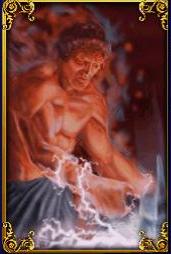
Physically, Hephaestus was generally represented as a sturdy and muscular man with a thick neck and hairy chest who, because of a shortened, lame leg and club foot, supported himself with the aid of a crutch. Bearded, this blue collar god most often was shown dressed in a ragged sleeveless tunic and woolen hat.

Most frequently, he was portrayed in art holding the heavy tools of his trade, especially the blacksmith's hammer and tongs. Sometimes in artistic depictions, he was surrounded by the Kabeiroi, the dwarflike blacksmith servants of the Mother Goddess who helped in his subterranean forge, deep below Olympus.

He was worshipped by all blacksmiths and artisans, who recognized him as their special patron and venerated him accordingly. Two great festivals, the Vulcanalia (celebrated by the Romans on August 23, the first day of Virgo) and the Hephaestia were celebrated in his honor.

Hephaestus was the one who split open the head of Zeus with an axe, when the King of the Olympians was suffering from a terrible headache. From the gaping head of Zeus emerged Athena. At the request of Zeus, and against his wishes, he also created the first woman, Pandora, who eventually unleashed a slew of evils upon the world.

Hephaestus was the only Olympian god who actually did physical work and he is worshipped for demonstrating that labor can be noble. He showed that it's not only important to do work, but to do so in an excellent and efficient fashion, and his skill was matchless. It's easy to see why he became the patron god of artists and craftsmen of all kinds, including weavers, painters, metalworkers, blacksmiths, leatherworkers, potters and builders.

His beautiful and detailed creations included the following wonders:

Aphrodite's golden girdle, which when worn made her irresistible

The bows and arrows of Artemis and Apollo

His robotic helpers, the handmaidens of gold, and the twenty three-legged stools that ran to service the banquets of the Olympians

The palaces and homes of the Olympians, with their unbreakable locks, as well as their twelve splendid thrones.

The famous Shield of Achilles

Heracles' (Hercules') golden breastplate

The exquisite Necklace of Harmonia

Athena's spear, Apollo's chariot and Demeter's sickle

The awesome scepter of Zeus

The golden bed of Helios, the sun god, which carries him as he sleeps

The armor of the gods in their war against the Titans

Various marvelous jewelry for Aphrodite and his Nereid surrogate mothers

The Aegis, emblazoned with the head of Medusa, carried by both Zeus and his daughter Athena

The invisible silver net that captured Aphrodite and Ares in bed

back to gallery
HEPHAESTUS GALLERY

[HOMEWORK HELP] [MYTH OF THE MONTH] [EMAIL] [PRIVACY POLICY]

Web, myth narration & graphics created & maintained by Nick Pontikis
Copyright © 1995 - 2010 Thanasi's Olympus Greek Restaurant
The Myth Man persona © 1988 Nick Pontikis
Copyright © 1999 mythman.com