|
MYTH MAN'S
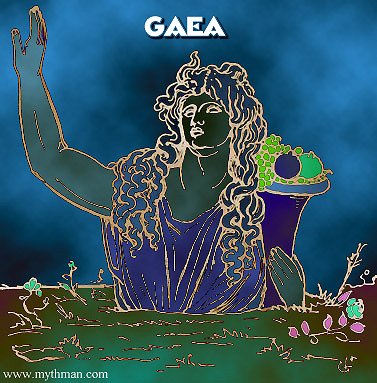
HOMEWORK HELP CENTER Gaea is the Earth goddess in Greek mythology, Terra Mater, who came out of Chaos and gave birth as she slept to her son Uranus (Ouranos), the Sky god. He showered fertile rain upon her secret clefts as he gazed down fondly upon her from the mountains, and she bore grass, flowers, trees, and birthed the astounding array of birds and beasts to populate them. The fertile rain of Uranus also made the rivers flow and lakes and seas came into being when the hollow places filled with water. She mated with her son and husband Uranus to produce the Titans, who joined their brothers in prison. First came the hundred-handed Hecatonchires, the giants Briareus, Gyges and Cottus. The three one-eyed Cyclopes were next, master smiths and builders of gigantic walls. Their names were Brontes, Steropes and Arges. But their relationship was so passionate, and the embrace of Uranus and Gaea (Sky and Earth) was so overwhelming, that their offspring could not emerge from her womb. You see, Uranus was afraid that one of his Titan children would end up overthrowing him and taking over rule of the Universe. The Titans were thus imprisoned by Uranus in Tartarus, a region of the Underworld. It was said that it would take a falling anvil nine days to reach its bottom. This caused Mother Earth great grief, so she conceived a great sickle that one of her children, Cronus, used to severe his father's genitals. The god Uranus was emasculated and the Sky separated from the Earth. From the blood of Uranus that fell on her, Gaea conceived the Eirynes (Furies), the avenging goddesses who pursued and punished murderers and evil-doers. The nymphs of the ash-tree, called the Meliae, also sprang from that blood. Uranus thus faded from the mythological scene and Cronus married his sister Rhea, becaming supreme ruler of the Universe. This was regarded by the Greeks as the Golden Age of the Titans. But Cronus was just as paranoid as his father, and in turn he swallowed all the children he fathered with his wife Rhea, afraid that they would do to him as he did to Uranus. On the advice of Gaea, Rhea gave Cronus a stone wrapped in baby blankets, and the gullible Cronus "swallowed" the ruse, instead of his baby boy Zeus. Eventually Zeus grew up to free his swallowed siblings and with their help indeed overthrew Cronus and became the supreme Olympian. Gaea may have saved Zeus from a fate similar to his father's when she warned him that any child born by Metis ('Thought'), whom Zeus desired as wife, would grow up to supplant him as King of the gods. Heeding Gaea's advice, Zeus swallowed Metis and in due time the goddess Athena sprang from his head. Mother Earth even proved helpful to Zeus in his fight versus Atlas and the Titans, shortly after taking power. However, she and Zeus parted company once her twenty-four sons, the Giants, attacked Olympus. (Many claim that this battle represented the last attempt to reassert female leadership over the heavens, symbolizing the war fought between those who preferred matriarchal (women-ruled) philosophies over those who wanted patriarchal ones.) Even though Gaea was one of the most prominent figures in the earliest myths, Mother Earth suffered a greatly diminished status with the eventual transfer of power to patriarchal (men-ruled) societies. She drifts between being an individual character and a personified conceptual entity representing the original life force of the earth. Gaea appeared in minor roles in a handful of later myths, but eventually the shift to Zeus' rule saw him being assigned most of her responsibilities and accomplishments. Mother Earth came to be perceived as more of a concept or metaphysical notion than an active goddess. She was never part of the Olympians' council of twelve, up on Mount Olympus, because she was considered too old and set in her ways to suit the new breed of gods.. The story of the separation between Earth and Sky is an ancient one, found in a variety of forms in West Asian mythology. Gaea seems to have started as a Neolithic earth-mother worshipped before the Indo-European invasion that eventually led to the Hellenistic civilization. She is the oldest of the goddesses and the personification of the "All-mother", or "Goddess of All Things", she who gives and takes life. Gaea's children with Uranus are the Titans, the Cyclopes, and the hundred-handed giants called the Hecatonchires. With Tartarus she is the mother of the monster Typhon and the Giants. Her Roman counterpart is Tellus, the fertile soil. While much Greek literature uses the name Gaea, Ge, Gaia or Gea, most modern readers will recognize her as Mother Earth.
|