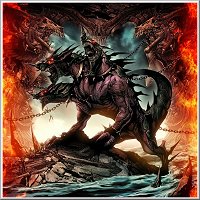
Cerberus, Hellhound
CLICK TO ENLARGE
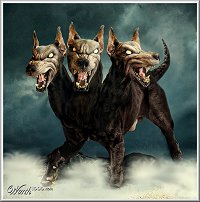
Cerberus
CLICK TO ENLARGE
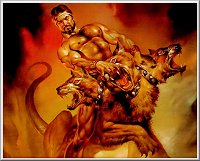
Hercules and Cerberus
by Boris Vallejo
CLICK TO ENLARGE
|
CERBERUS PAGE ONE
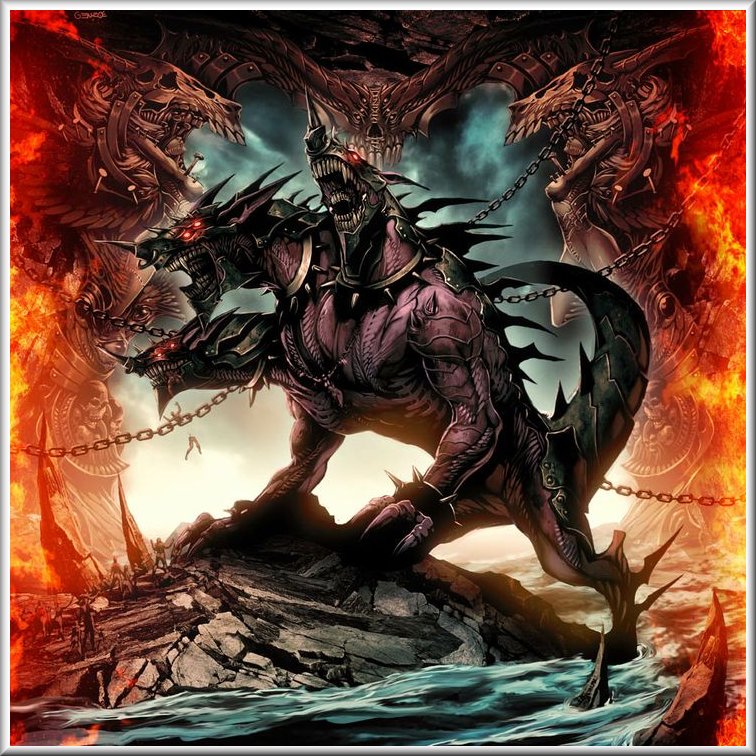
Cerberus was a multi-headed dog, or "hellhound", as he was
called. He had a serpent's tail, a mane of snakes, and a lion's
claws. His role was to guard the entrance of the Underworld, the
realm of Hades, in order to prevent the dead from escaping and
the living from entering without his master's permission.
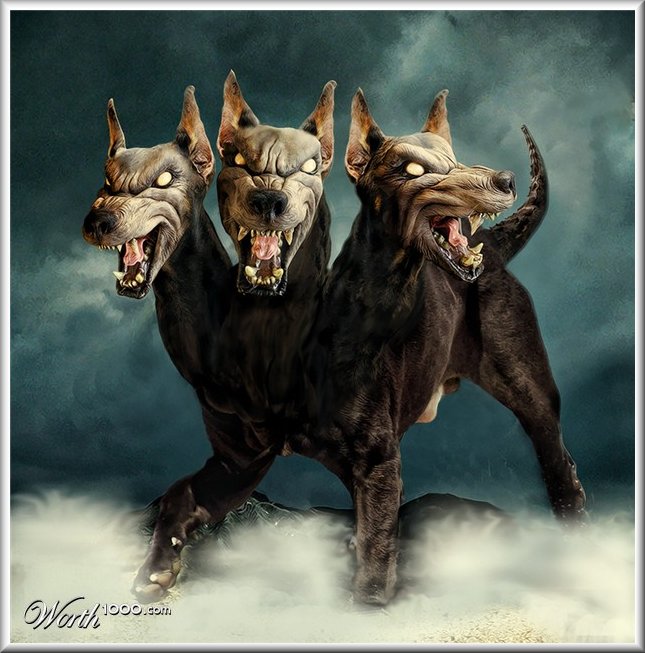
Most sources attribute three heads to Cerberus, although some
ancient writers have endowed him with one, two, fifty heads
(Hesiod) and as many as one hundred (Horace). The center head
was in the shape of a lion, while the other two were in the
shape of a dog and a wolf, respectively.
Cerberus' father was Typhon, a huge dragon-like monster so
horrible that even the Olympian gods ran and hid from him when
he first appeared, even taking on the shape of animals to
escape. It took the goddess Athena to shame and goad Zeus into
confronting Typhon, and after an epic battle, burying him under
Mount Aetna.
Cerberus' mother, Echidna, had the head and torso of a beautiful
woman, though the lower part of her body was that of a speckled
serpent. She dwelled in a cave where she ate men raw. With her
husband Typhon she raised a monstrous brood which included the
Hydra, the Chimaera, Orthrus the two headed hellhound, and,
according to some sources, the Sphinx, as well as Cerberus.
The most common depiction of Cerberus in Greek mythology and art
is as having three heads. His three heads each respectively see
and represent the past, the present, and the future, while other
sources suggest the heads represent birth, youth, and old age.
Cerberus' three heads are said to have an appetite only for live
meat and thus allow only the spirits of the dead to freely enter
the underworld, but none are permitted to leave. There were only
a few notable exceptions, as we will see.
Cerberus was always employed as Hades' loyal watchdog, and
guarded the gates that granted access and exit to the
underworld. You can consider him as the watchdog of hell.
There he lay, snarling and vicious, chained to the entrance
gates of Acheron, harassing the spirits entering Hades and
devouring those that tried to escape. His Egyptian incarnation
was Anubis, the dog that guarded the tombs and conducted the
souls to the underworld.
The final and most difficult of Heracles' (Hercules') twelve
labors was to bring Cerberus up to the earth from the Underworl.
Hercules was told by the lord of the Underworld, Hades, that he
could take Cerberus if he could do so without using weapons.
Hades was certain that Hercules would fail in this task, hence
he did not worry about losing his watchdog to the hero.
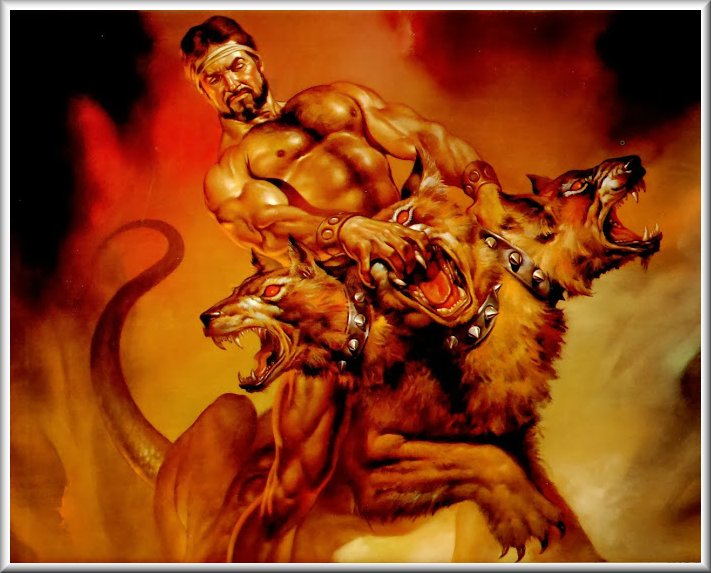
When Hercules found Cerberus on the shore of Acheron, he began
to wrestle with the huge monster. Hercules was the world's
strongest man, and it took all his power to subdue Cerberus.
He seized hold of the beast's throat and squeezed with all his
might. Hercules wasn't trying to kill the dog, just knock him
out so he could bring him to King Eurystheus, who had commanded
the deed, and thus complete his labor.
Cerberus' barbed and poisonous tail whipped the air but, unable
to pierce the lion pelt worn by the Greek, the monster soon grew
weary, and having ran out of breath by the strongman's
chokehold, it finally realized it was beated and yielded to
Hercules.
Heracles proceeded to sling the beast over his back, dragging it
out of the Underworld through a cavern entrance in the region of
the Peloponnese. He carried it King Eurystheus, who was a real
sissy. The king was so frightened of the beast that he jumped
into a subterranean jar he had constructed and hid.
He shouted orders through the jar for Hercules to immediately
return Cerberus to his home in the Underworld, and promised
Hercules that if he obeyed, Eurystheus would release him from
his labors.
Cerberus concludes on page two!
LOTS MORE INFO AND PIX
CLICK HERE!

|