MYTH MAN'S AWARD WINNING
HOMEWORK HELP CENTER

APHRODITE, GODDESS OF LOVE,
BEAUTY, FERTILITY & DESIRE
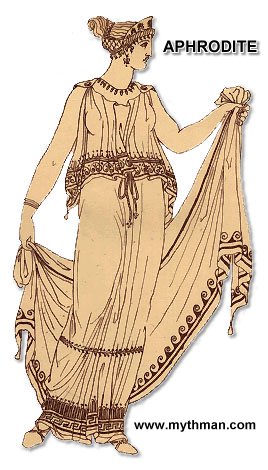
APHRODITE Quick Kiss Version The irresistible Aphrodite was the ancient Greek goddess of Beauty and Love, Fertility and Desire. There are two accounts of her birth. In the Iliad, the ancient writer Homer said that she was the daughter of Zeus and Dione. But later myths and poems say that the goddess of Love had risen from the sea foam on a seashell after Cronus tossed Uranus severed genitals there. Her name was thus explained as "foam-risen" coming from the Greek word 'Aphros', which means 'foam'. It is said that "when Aphrodite was born the Horae (also known as the Hours or the Seasons) welcomed her joyously and they clothed her with heavenly garments. They put on her head a crown of gold, and in her pierced ears they hung bejeweled golden ornaments. Then they adorned her with golden necklaces and the kind of jewels which the Horae wear themselves whenever they join the dances of the gods." Both in modern and ancient times, the picture that poets, writers and artists liked to paint of her was of beauty and happiness; The winds flee before her and the storm clouds; sweet flowers embroider the earth; the waves of the sea laugh; she moves in radiant light. Without her there is no joy nor loveliness anywhere. Although the later poems talked about her beauty and sweetness, they usually showed her other side as well, for she was treacherous and malicious, often exerting a destructive and deadly power over men. Through this control she gained quite an influence, both on earth and in heaven. It was said that when she spoke, even Zeus listened...after all, the King of the Olympians was notorious for succumbing to Love's temptations. The lame god of the forge and metalworking, Hephaestus, was her husband, although he was the only god to be physically ugly. It was an arranged marriage - Some say that when Aphrodite first arrived on Mount Olympus, Zeus was struck by her beauty and radiance and he was certain that the other gods would fight for her affections. So he awarded Aphrodite to the most dependable and steady deity, Hephaestus. Her husband did his utmost to please his gorgeous bride, continuously creating and designing new golden jewelry and furniture to please her. In addition to her irresistible looks Aphrodite had a magical golden girdle, made by Hephaestus, that when worn compelled anyone she wished to desire her. As if she weren't irresistible enough already!
Up on Mount Olympus, Aphrodite sat on a silver throne, inlaid with beryls and aquamarines, with a back shaped like a scallop shell, soft swan's down covering the seat, and a golden mat for her feet that was embroidered with golden bees, apples and sparrows. Once a year she would visit Paphos, on the island of Cyprus, to swim in the sea for good luck and to rejuvenate herself. Opposite Aphrodite sat the god of War, Ares, and the two had an ongoing notorious love affair that scandalized all of Olympus. Ares and Aphrodite were always holding hands and giggling in the corners of the palace, which made her husband Hephaestus very jealous. He even fashioned an invisible net and captured the two lovebirds one time, but when he assembled the Olympians to render judgment, they wanted nothing to do with punishing them. Zeus even told Hephaestus that he was stupid to make such a golden girdle for his wife, and that he shouldn't be surprised that men could not resist her. Her attendants were the Horae (Hours, Seasons, who are worshipped as the wardens of the sky and of Olympus and are also said to attend to the Sun god, Helios) and the Three Graces (Aglaia, Euphrosyne and Thalia, known in Greek as the Charites); Flora and Zephyrus were ready to do her bidding as well. She was the patroness of gardens and gardeners as well as lovers. The myrtle was her tree; the rose, lily, hyacinth, crocus and narcissus were also sacred to her. Her animals were the swan, the dove, the sparrow and the dolphin. The Romans called her Venus.
*Myth Man's Aphrodite Myth of the Month is here
|
![]()
Web, myth narration & graphics
created & maintained by Nick Pontikis
Copyright © 1995 - 2003 Thanasi's Olympus Greek Restaurant
The Myth Man persona © 1988 Nick Pontikis
Copyright © 1999 greekmyth.com
Copyright © 1999 mythman.com